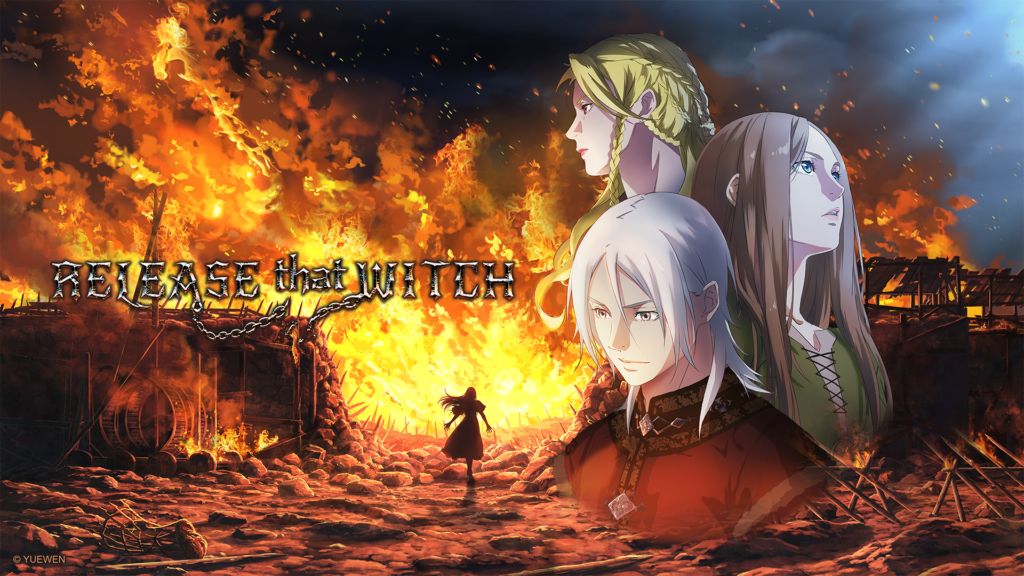
An engineer wakes up as the fourth prince of a medieval kingdom, gets exiled to a frontier town nobody wants, and finds out the Church is burning women who can throw fire. He hires them. That is the entire pitch of Release That Witch, and it’s still the first book I recommend to anyone who asks where kingdom building starts.
The short version of this Release That Witch review: no system, no cheat skill, no power-ups, and he still wins. Readers agree. On Webnovel it holds a 4.65 rating from almost 6,000 reviews and more than 145 million views, years after the final chapter went up.
At a glance
- Series Release That Witch
- Author Er Mu
- Format Chinese web novel in English translation; 8-episode anime (2026)
- Subgenre Kingdom building, progression fantasy
- Length 1,498 chapters, complete
- Rating 4.65 / 5 on Webnovel (5,986 ratings)
- Best for Modern-knowledge uplift, an underdog prince, a town that visibly levels up
- Spoilers Light, first-arc setup only
It’s finished
Start with the practical reason, because it matters more than people admit. Release That Witch finished serialising in 2019. Every chapter exists. You can read ten a night or three hundred over a weekend, and the story will not stop on a cliffhanger while the author takes a two-year break.
Most kingdom building recommendations come with a warning attached: ongoing, on hiatus, or dropped at chapter 400. Release That Witch doesn’t. For a genre where the payoff is watching a town grow over hundreds of chapters, knowing the growth actually reaches an ending is half the appeal.
The underdog setup is perfect
Roland Wimbledon is the prince nobody rates. His siblings get real territories for the succession contest; he gets Border Town, a mining settlement on the edge of the map that gets hit by demonic beasts every winter. Everyone in Graycastle has already written him off, which in this genre is less a weakness than a down payment.
What makes it work is that Roland has no system, no cheat skill and no secret bloodline. He has an engineer’s memory and a frontier town’s worth of mud, and the novel is happy to make him build everything from there. The early steam engine chapters are slow in the right way: you feel every step from “we can’t make reliable iron” to “the pump works”.
Everyone in Graycastle has already written him off, which in this genre is less a weakness than a down payment.
Progression Library
Roland wins with his head
The thing readers praise most about Release That Witch is that Roland is actually smart. He doesn’t cultivate, doesn’t train, doesn’t wait for a power-up. He reads a problem, works out what it needs and builds it. He wins most of his fights without throwing a punch. That is kingdom building done properly: the problems are logistics, and the answers are engineering.
It also skips the genre’s most tired habits. Nobody in Graycastle cares about face. No young master informs Roland that he is an ant, and no arc ends with someone apologising for having eyes but failing to see Mount Tai. The science is school-level physics and chemistry used properly, and a surprising number of readers say they learnt more from it than they did in class.
The witches are the engine
This is the idea that sets Release That Witch apart from every other modern-knowledge story. Roland’s knowledge alone would take decades to turn into factories. The witches close the gap. Anna’s fire becomes precision metalworking. Other witches become surveyors, healers, chemists and production lines, each one slotting a magical ability into a gap in the industrial chain.
It turns rescuing the witches into the kingdom building itself. Every witch who reaches Border Town is a person saved from the Church and a new technology unlocked, so the emotional story and the building story pull in the same direction. Few books in the genre manage that.
The best detail is which powers turn out to matter. Abilities the Church, and often the witches themselves, wrote off as useless are exactly the ones an industrial town needs most. Roland also treats magic as something to measure. He tests what each witch can do, tracks her limits and teaches her the science behind it, and the witches get stronger as a result.
Progression fantasy where the town levels up
If you’ve come to this Release That Witch review from Cradle or The Primal Hunter, adjust one expectation: the protagonist never gets stronger. Roland ends the novel as physically ordinary as he started it. Everything around him levels up instead.
Border Town is the character with the progression arc. Population, food, iron output, firearms, rail: each one climbs a tier, and each tier unlocks the next problem. There is no status screen. The census does the job. The early grind for usable steel is what makes the later factories land, the same way forty chapters of bottleneck make a breakthrough land.
That is the bridge between the two genres, and it’s why so many progression fantasy readers end up in kingdom building through this book.
The reforms are selfish, and that’s why they work
Roland ends the witch hunts in his territory, turns serfs into paid workers and teaches his people to read. He isn’t a saint about any of it. Factories need literate workers, engineers who aren’t afraid of being burnt, and a population with a reason to stay. The novel never pretends otherwise, and the reforms land harder because of it.
The cast are people
Webnovel tags it HAREM. It is not a harem. The romance is slow, mostly with one person, and the witches have their own arcs, opinions and rivalries rather than orbiting Roland. Even the antagonists get room: the Church’s leadership, Roland’s siblings and the nobles who sneer at him early on all have backstories, and the novel regularly hands them the point of view.
Underneath the town-building, Release That Witch also runs a mystery: why witches exist, what the Church knows, and what is really behind the demons. It pays out slowly, and it gives the long middle a reason to keep turning pages.
Release That Witch review: the short version
What works
- Visible progress. Walls, cement, steam engines, rifles, rail. Each arc ends with Border Town measurably different from how it started.
- Problems get solved with engineering. Roland wins by out-building people, not out-fighting them, and the novel rewards you for following how.
- A cast that grows with the town. Nightingale, Anna, Lightning and the rest get their own small arcs inside the big one.
- It’s the template. A lot of what readers now expect from modern-knowledge kingdom building was set by this book. Reading it explains half the genre.
What drags
- The tech runs too fast. The early chapters earn every invention. Later, the jump from steam to modern weaponry happens on a timeline that would make the industrial revolution file a complaint. Witch powers explain some of it, not all.
- It’s too smooth. Problems get solved a little too easily, and healing magic means injuries rarely stick. There’s not much sense that Roland might actually lose.
- Roland barely changes. He’s the same capable engineer at chapter 1,400 as at chapter 40. The witches carry most of the emotional growth.
- Too many witches, not enough room. The cast keeps growing, and past a certain point new witches arrive as abilities first and characters second. Some early favourites fade into the background.
- The war takes over. The later arcs shift from building a town to fighting an enemy on a world-ending scale. It’s competent war fiction, but it isn’t the kingdom building you came for, and it stretches.
- The late twist splits readers. Without spoiling it: the final stretch takes the story somewhere far more metaphysical than Border Town. Some readers call it the payoff the whole book was building to. Others call it a different novel bolted onto the end.
- The translation is serviceable, not elegant. It does the job. It won’t win anyone over on prose.
- Some things break the spell. Out-of-place modern pop culture references, and a camera that lingers on the witches longer than it needs to.
- Reading it legally isn’t cheap. Webnovel locks most of it behind its coin system, and 1,498 chapters adds up.
None of these sink it. They’re the reason the first half is a 10 and the whole thing is an 8.
Read it or watch the anime?
The 2026 donghua from Thundray is eight episodes and covers the opening of the Border Town arc. It’s a decent trailer for the novel and nothing more: it stops right where the story starts building in earnest. Watch it if you want to know whether you like Roland. Read Release That Witch if you want the kingdom.
Where to start reading Release That Witch after the anime
Episode 8 ends on the first snow. Start at chapter 40, where the Months of Demons begin.
Verdict 4 / 5
Release That Witch is still the kingdom building novel the genre measures itself against. It’s complete, it has the best underdog setup in the genre, it’s the easiest way into kingdom building for progression fantasy readers, and its central idea, that rescuing witches is how you industrialise, is one nobody has bettered. The later arcs sprawl and the ending will divide you. Read it anyway, then come back for the rest of the genre.